


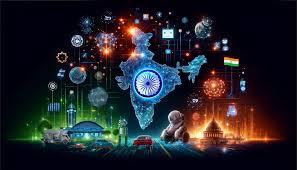
The global race for a dominant Artificial Intelligence Market Share is being profoundly influenced by the meteoric rise of India as a digital-first nation. The Indian market represents one of the largest and most dynamic "greenfield" opportunities for AI adoption on the planet. This unprecedented growth is underpinned by a powerful confluence of factors: the world's largest population, a massive and rapidly expanding internet user base exceeding 800 million, the world's most affordable mobile data tariffs, and a unique, government-driven digital public infrastructure known as the "India Stack," which includes the Aadhaar biometric identity system and the Unified Payments Interface (UPI). This foundation has catalyzed a nationwide digital transformation, compelling businesses of all sizes to adopt technology at a breakneck pace. Consequently, the demand for AI to drive operational efficiency, create personalized customer experiences, and manage the immense scale of digital operations has exploded. Unlike the more mature markets of North America and Europe, where AI adoption often involves augmenting or replacing legacy systems, the opportunity in India is frequently to build entirely new, AI-native systems from the ground up. This unique context makes the battle for market share in India a critical determinant of long-term global leadership in the AI industry.
Key Players
The key players vying for a dominant share of the Indian AI market form a distinct and highly competitive triad. The first and most powerful group are the global cloud hyperscalers: Amazon Web Services (AWS), Microsoft Azure, and Google Cloud Platform (GCP). These US-based giants are the primary "arms dealers" of the AI revolution in India, providing the essential, scalable infrastructure-as-a-service (IaaS) and, more importantly, the advanced platform-as-a-service (PaaS) offerings for AI and machine learning. Their immense R&D budgets and comprehensive service portfolios make them the foundational layer for a huge portion of the Indian AI ecosystem. The second group of key players consists of India's own world-class IT services behemoths, including Tata Consultancy Services (TCS), Infosys, and Wipro. These firms are not primarily product companies, but they capture a colossal share of the market's value by acting as the crucial system integrators and managed service providers. They are the "last mile," helping large Indian enterprises to design, implement, and manage their complex AI solutions, often leveraging the platforms of the global hyperscalers. The third, and increasingly vibrant, group is the burgeoning Indian AI startup ecosystem. These agile companies, often funded by both domestic and international venture capital, are developing innovative AI products and solutions, sometimes tailored specifically to the unique challenges and data realities of the Indian market.
Future in "Artificial Intelligence Market Share"
The future of the AI market share battle in India will be defined by a decisive shift "up the stack" from basic infrastructure to higher-value services and by a growing emphasis on data sovereignty. The competition will evolve beyond who can offer the cheapest virtual machine to who can provide the most powerful and easy-to-use platform for data analytics, machine learning model development, and, most significantly, generative AI. The cloud provider that can offer the best tools for Indian enterprises to build their own custom AI applications and leverage large language models will be best positioned to capture future share. A second major future trend will be a much greater emphasis on industry-specific "vertical clouds." The hyperscalers will increasingly compete by offering tailored solutions for India's key sectors, such as financial services (BFSI), retail, and manufacturing, complete with industry-specific data models and compliance frameworks. A third and uniquely Indian factor will be the growing strategic importance of data residency and sovereignty. The companies that can best navigate India's evolving data protection laws and offer robust, in-country cloud solutions will have a major advantage in winning lucrative government and public sector contracts, a different dynamic than the more open cross-border data flows seen in regions like North America.
Key Points "Artificial Intelligence Market Share"
This strategic overview highlights several crucial points about the artificial intelligence market share in India. Firstly, the market's immense growth is being driven by a unique, large-scale national digital transformation, creating a "greenfield" opportunity unlike that in more mature Western markets. Secondly, the market share is being contested by a powerful triad of global cloud hyperscalers, dominant Indian IT services firms who capture the services layer, and a rapidly growing domestic startup ecosystem. Thirdly, the future battle for market share will be fought over higher-value PaaS, AI platforms, and industry-specific solutions, not just basic infrastructure. Finally, India's unique focus on digital public infrastructure and its evolving data sovereignty regulations create a distinct competitive landscape that requires a deeply localized strategy for any player hoping to achieve a significant and lasting market share. The Artificial Intelligence Market Share is projected to grow to USD 54.04 Billion by 2035, exhibiting a CAGR of 18.2% during the forecast period 2025-2035.
Top Trending Reports -
Mobile Value Added Services Market Size

 English
 Arabic
 French
 Spanish
 Portuguese
 Deutsch
 Turkish
 Dutch
Dutch
 Italiano
 Russian
 Romaian
 Portuguese (Brazil)