


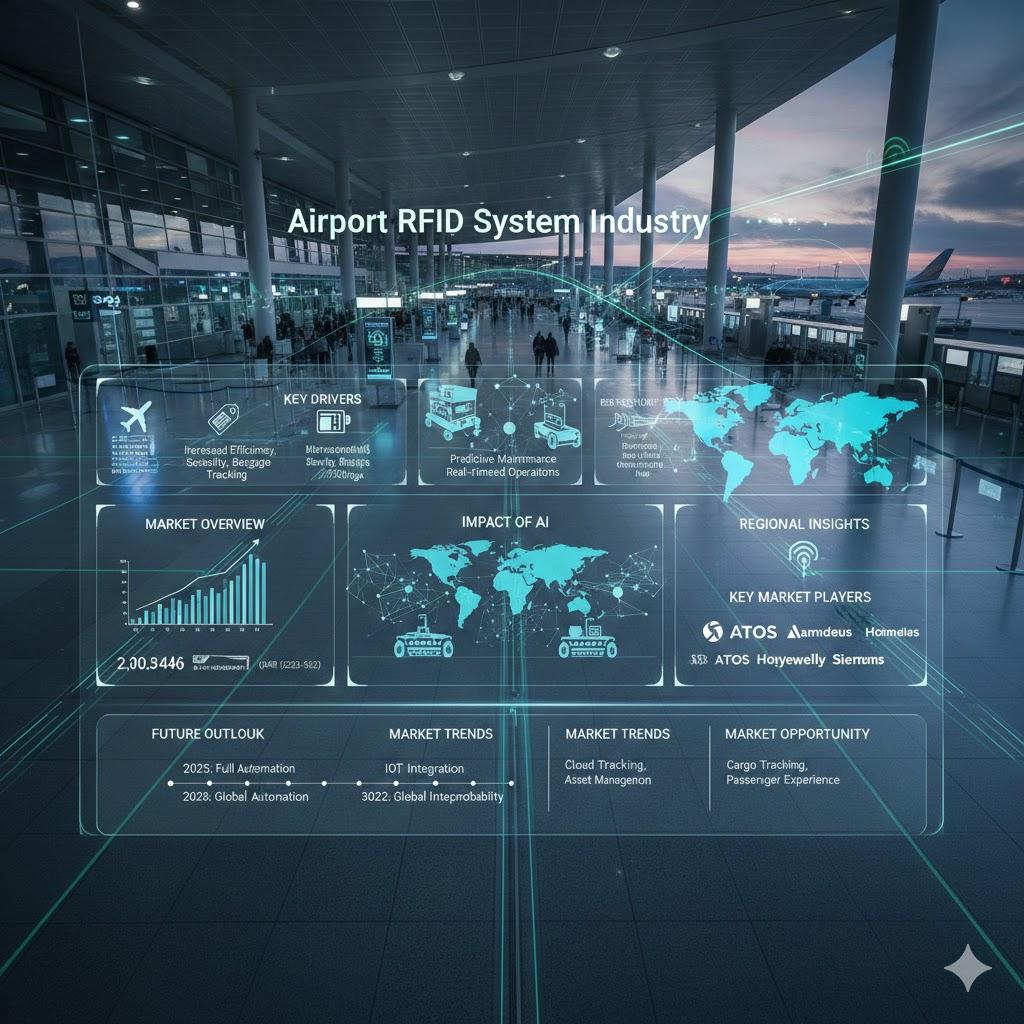
The Airport RFID System Market is structured around multiple segmentation dimensions that influence how airports and airlines adopt and deploy RFID technology. As per MRFR, the market, valued at USD 2.808 billion in 2024, is expected to grow to USD 7.446 billion by 2035, at a CAGR of 9.27% over the forecast period.
One of the key segmentation categories is application, which includes baggage tracking, asset tracking, passenger tracking, and flight information systems. Of these, baggage tracking represents a significantly large market share due to the ongoing industry focus on reducing lost or mishandled luggage and enhancing traveler satisfaction. RFID solutions provide precise, real-time baggage tracking so airports can offer improved service and minimize the costs associated with misplaced bags.
Asset tracking is another influential application segment that is gaining momentum. Airports manage vast inventories of ground support equipment, tools, and vehicles that require consistent monitoring and maintenance. RFID systems help optimize asset utilization, reduce theft or loss, and promote better resource allocation—all of which enhance operational efficiency.
The component perspective covers RFID tags, RFID readers, software, and RFID middleware. RFID tags represent the foundational units of the system, attached to baggage, assets, or equipment to enable identification. They continue to hold a dominant market position due to high demand for tagging individual items. RFID readers are essential for capturing data and transmitting it into airport networks, and their adoption is growing as airports expand infrastructure. Meanwhile, software and middleware are emerging as high-value segments, enabling the integration of RFID data with broader airport IT systems.
Technology segmentation includes active, passive, and semi-passive RFID. Active RFID—powered by its own energy source—offers reliable long-range tracking and is widely used for critical applications such as baggage and asset tracking in large airports. Passive RFID, although not as advanced in range, is gaining acceptance due to its cost effectiveness and ease of deployment. Semi-passive RFID combines elements of both active and passive systems, providing flexible solutions for varied use cases.
From an end-use perspective, the market serves airports, airlines, and cargo operators. Airports currently represent the largest end-use segment—driven by investment in automated baggage systems and comprehensive RFID deployment across terminals. Airlines are the fastest-growing end-use segment, increasingly adopting RFID to improve customer experience and operational coordination. Cargo operators also rely on RFID solutions to track goods and ensure compliance with security standards.
Regional dynamics further illuminate market behavior. North America leads the global market due to its early adoption of RFID technology, sophisticated airport infrastructure, and stringent security regulations. Europe follows closely with major airports investing in RFID for tracking and security. The Asia-Pacific region is the fastest-growing market, spurred by rapid airport expansions and rising air travel demand.
In conclusion, the Airport RFID System Market’s segmentation by application, component, technology, and end-user provides a nuanced view of industry dynamics, reflecting how various sectors leverage RFID technology to enhance efficiency, visibility, and security in modern airport operations.
Related Report:
Airport Surveillance Radar Market

 Arabic
 French
 Spanish
 Portuguese
 Deutsch
 Turkish
 Dutch
Dutch
 Italiano
 Russian
 Romaian
 Portuguese (Brazil)
 Tiếng Việt