


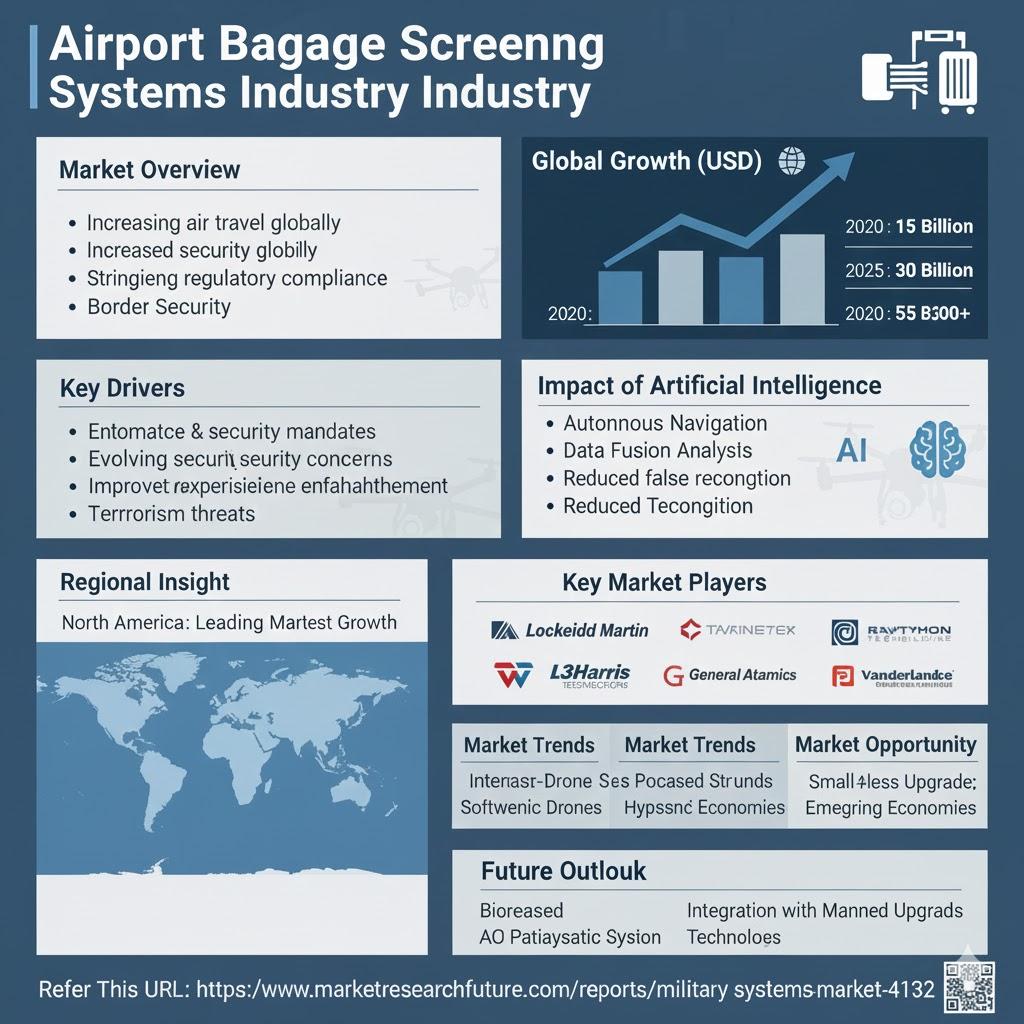
The Airport Baggage Screening Systems Market is defined by robust competition and rapid technological progression, with manufacturers striving to offer advanced, efficient, and secure solutions to airports worldwide. As reported by (MRFR), the market is expected to grow from USD 2.29 billion in 2024 to USD 4.593 billion by 2035, registering a CAGR of 6.53% during the forecast period.
Market competition in this sector centers on product innovation, service quality, and the ability to meet stringent aviation security requirements. Key players dominating the landscape include Smiths Detection, L3Harris Technologies, Rapiscan Systems, Nuctech Company Limited, Vanderlande Industries, SITA, C.E.I.A. S.p.A., Scanna, and Kromek Group. These companies continually invest in research and development to introduce screening systems that combine speed, accuracy, and reliability while addressing evolving security challenges.
The competitive focus lies in differentiating through cutting-edge technologies. Artificial intelligence (AI) and machine learning integration are becoming essential features of next-generation screening systems, enabling threat detection with higher precision and lower false alarm rates. Additionally, manufacturers are streamlining user interfaces, enhancing automation, and improving remote monitoring capabilities to support airport operations more effectively.
Strategic partnerships and collaborations play a crucial role in strengthening market positions. Several key technology providers collaborate with airport authorities to tailor screening solutions that align with specific security and throughput needs. These partnerships also involve training programs that ensure airport staff can maximize the capabilities of new systems.
Another competitive trend is the emphasis on modular and scalable solutions. Airports of varying sizes—from major international hubs to regional terminals—require screening solutions that match their operational requirements and budget constraints. Modular systems help smaller facilities adopt advanced technologies without large upfront investments, fostering broader market reach for suppliers.
Looking forward, the Airport Baggage Screening Systems Market is poised for continued innovation. As regulatory bodies update security standards in response to emerging threats, screening technologies will need to evolve accordingly. This includes developing systems capable of integrating real-time analytics, cloud-based monitoring, and predictive maintenance—features that improve both security and operational resilience.
Future outlook for the market remains strong. Airports will increasingly adopt high-speed CT scanners, dual-energy X-ray units, automatic threat recognition software, and integrated conveyor screening lines that reduce processing times and improve passenger satisfaction. Growth in e-commerce and increased cargo transport will drive demand for advanced screening systems that handle diverse baggage types and high throughput.
Additionally, emerging markets in Asia-Pacific, South America, and MEA are expected to contribute significantly to market expansion as these regions continue to modernize airport infrastructure and upgrade security capabilities to international standards.
In conclusion, the competitive landscape of the Airport Baggage Screening Systems Market is defined by technological leadership, partnerships, scalability, and regional demand. With sustained innovation and growing global air travel, the market is on track for strong growth through 2035
Related Report:

 English
 Arabic
 French
 Spanish
 Portuguese
 Deutsch
 Turkish
 Dutch
Dutch
 Italiano
 Russian
 Romaian
 Portuguese (Brazil)